TBPM
基于紧束缚近似的数百万至十亿原子模拟
Simulation of Multimillion-To-Billion Atoms within Tight-binding Approximation
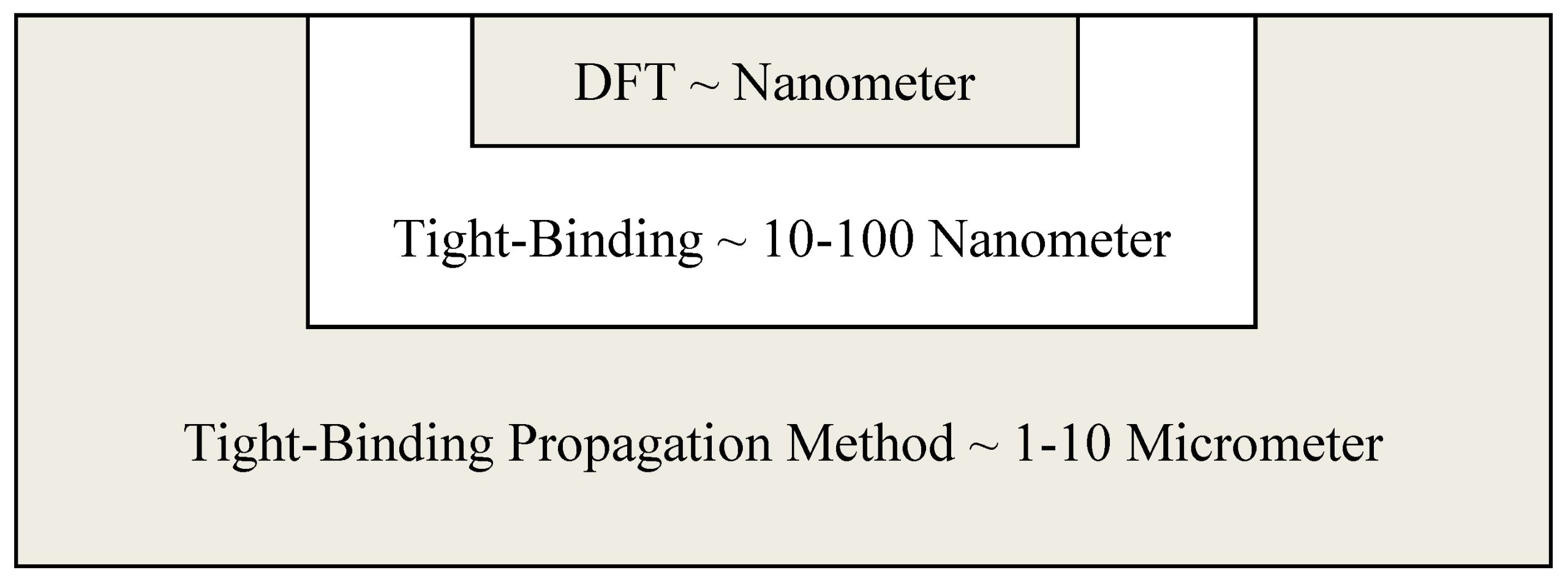
我们发展了紧束缚传播方法(TBPM),在紧束缚模型的框架之下,以基于含时薛定谔方程的电子波传播为理论基础,进行大尺度物性计算:
The newly developed tight-binding propagation methods (TBPM) are based on the wave propagation of electron according to the time-dependent Schrödinger equation, and applied in the calculations of the following subjects:
电子性质:态密度、局域态密度、Landau 能级、准本征态;
输运性质:电导率、扩散系数、平均自由程、局域化长度、载流子速度与迁移率、隧穿概率;
光学性质:光导率、光透过率与吸收率;
屏蔽性质:极化函数、响应函数、介电函数、能量损失函数、等离激元;
该方法的计算量仅随体系规模线性增长,可在无需对角化的情况下对包含数十亿原子的体系进行模拟。数值方法的详细内容可参见
Phys. Rev. B 82, 115448 (2010),
Phys. Rev. B 84, 035439 (2011),
Phys. Rev. B 91, 045420 (2015),
Nature
Communications 11, 371 (2020),
以及 Comp. Phys. Comm.
285, 108632 (2023)。
Electronic properties: density of states, local density of states, Landau levels,
quasieigenstates;
Transport properties: electronic conductivity, diffusion coefficients, mean free path,
localization length, carrier velocity and mobility, tunneling probability;
Optical properties: optical
conductivity, light transmittance and absorbance;
Screening properties: polarization function, response
function, dielectric function, energy loss function, plasmon life time, plasmon damping rate;
The computational
effort increases only linearly with the system size, and it is possible to calculate systems up to billions of atoms
without any diagonalization. The details about the numerical methods are described in Phys. Rev. B. 82, 115448 (2010), Phys. Rev. B 84, 035439 (2011), Phys. Rev. B 91, 045420 (2015), Nature
Communications 11, 371 (2020), and Comp. Phys. Comm. 285, 108632 (2023)..
DFPM
可用于数百万原子模拟的大尺度密度泛函理论算法
Simulation of Multimillion Atoms within Density Functional Theory
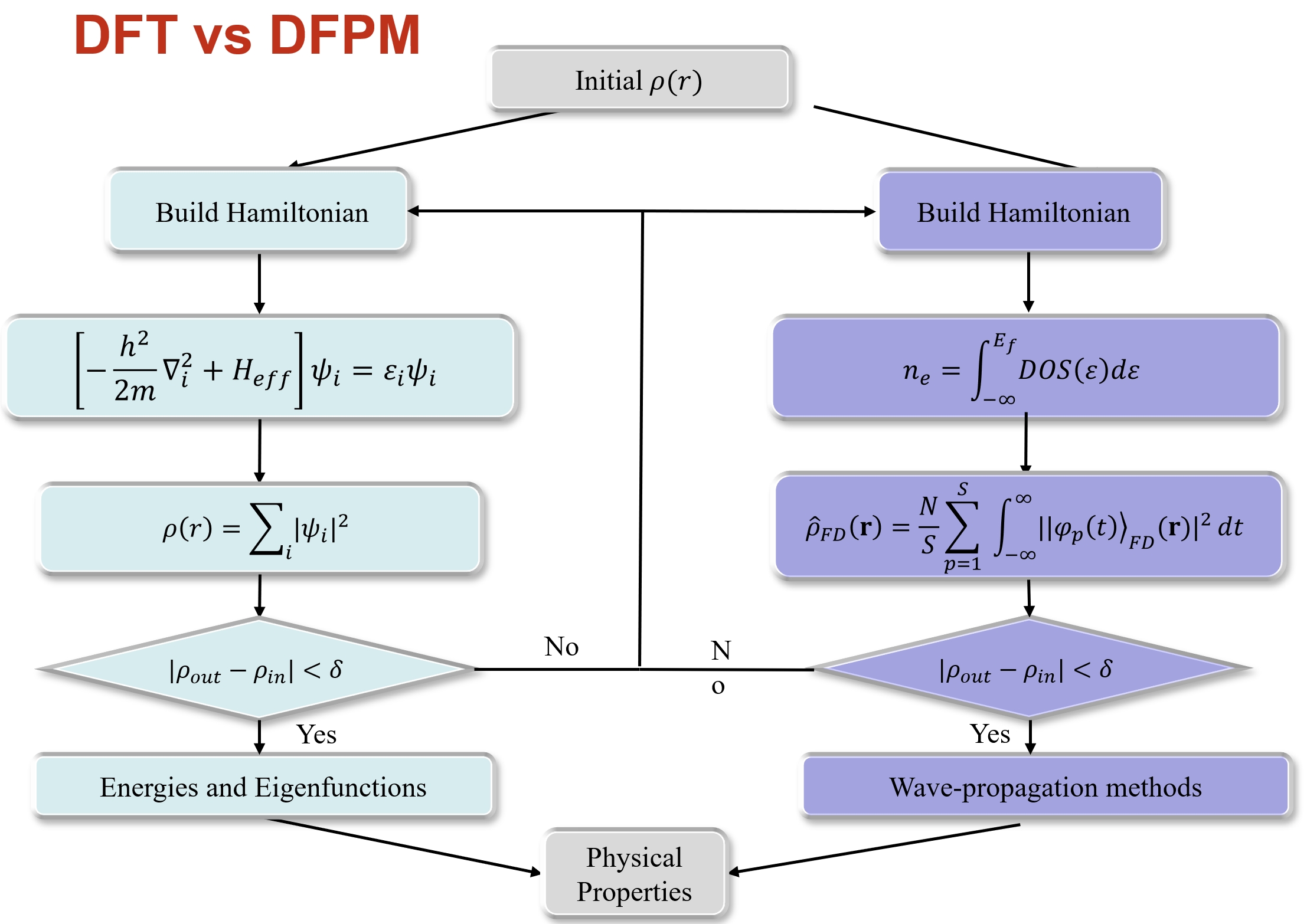
密度泛函传播方法(DFPM)是一种完全自洽的基于密度泛函理论的从头计算方法,无需进行任何对角化。与传统的 Kohn-Sham 方法不同,DFPM 中电子密度的实空间分布是通过随机态在时域上的平均,从哈密顿量直接获得的。其内存开销和计算时间均与体系规模线性相关,可在中等硬件配置的计算机上对数百万原子体系进行自洽密度泛函理论计算。数值方法的详细内容可参见 A Time-Dependent Random State Approach for Large-scale Density Functional Calculations, Chin. Phys. Lett. 40, 027101 (2023) (Express Letter) 。
The newly developed density functional propagation method (DFPM) is a fully self-consistent first-principle calculation method based on density functional theory without any diagonalization. Different from the traditional Kohn-Sham method, the real-space distribution of electron density in DFPM is obtained from the Hamiltonian without any diagonalization. The memory cost and computational time are linearly dependent on the system size. It is possible to perform self-consistent density functional theory calculations with millions of atoms on computers with moderate hardware. The details about the numerical methods are described in A Time-Dependent Random State Approach for Large-scale Density Functional Calculations, Chin. Phys. Lett. 40, 027101 (2023) (Express Letter) .
低维量子体系
Low-dimensional Quantum Systems
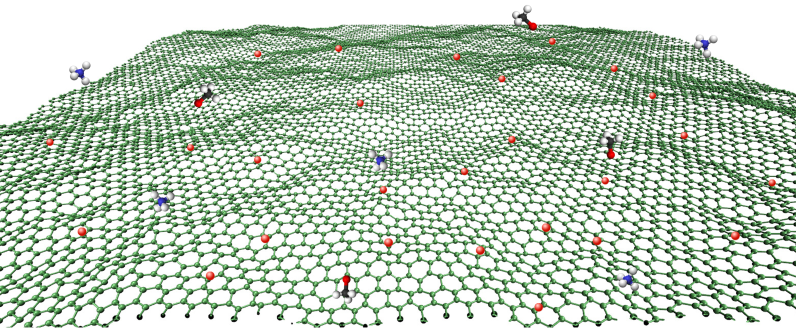
低维量子体系,例如二维(2D)材料、一维(1D)纳米管和零维(0D)量子点,由于维度降低,与传统的三维(3D)材料不同。它们具有许多有趣的物理性质,对未来新型电子器件和光子器件的发展至关重要。我们结合了多种理论方法,包括从头计算、紧束缚近似、分子动力学模拟以及其他多种最先进的数值方法,深入研究低维量子体系新颖性质,并与全球实验组保持紧密合作。
Low-dimensional Quantum Systems, such as two-dimensional (2D) materials, nanotubes (1D) and quantum dots (0D), are different from conventional three-dimensional (3D) materials due to the reduced dimensionality. They have many interesting physical properties and are believed to be essential for the development of new electronic and photonic devices in the future. A deep understanding of the novel properties of low-dimensional quantum systems is carried out theoretically and numerically, with strong collaborations with experimental groups worldwide. Combinations of different theoretical approaches, including first-principles calculations, tight-binding approximation, molecular dynamics simulations, and many other state-of-the-art numerical methods, have been implemented in the study of these systems.
代表性论文
量子点中的偏振依赖选择规则 , Phys. Rev. X 12, 021055 (2022)
周期性耦合的零阶伪 Landau 能级, Phys. Rev. Lett. 129, 056803 (2022)
单层六方 WS2 中的激子光致发光 , Advanced Optical Materials, 2101971 (2022)
石墨烯气体不透性的极限,
Nature 579, 229 (2020)
单层卤化物双钙钛矿的横向异质结构 , ACS Energy Lett. 5, 2275 (2020)
氧功能化 MXenes 的压电效应 , Nano Energy 65, 104058 (2019)
调控黑磷二维超曲等离激元 , Phys. Rev. Applied 12, 014011 (2019)
氟化石墨烯 , Phys. Rev. Lett. 114, 047403 (2015)
Selected Publications
Polarization-dependent selection rules in quantum dots , Phys. Rev. X
12, 021055 (2022)
Periodically Coupled Zeroth Pseudo-Landau Levels, Phys. Rev. Lett. 129,
056803 (2022)
Exciton Photoluminescence in Monolayer Hexagonal WS2 , Advanced Optical
Materials, 2101971 (2022)
Limits on gas
impermeability of graphene, Nature 579, 229 (2020)
Lateral Heterostructures of Monolayer Halide Double Perovskites , ACS
Energy Lett. 5, 2275 (2020)
Piezoelectricity of oxygen functionalized MXenes , Nano Energy 65,
104058 (2019)
Tuning 2D hyperbolic plasmons in black phosphorus , Phys. Rev. Applied
12, 014011 (2019)
Fluorinated Graphene , Phys. Rev. Lett. 114, 047403 (2015)
Moire 超晶格
Moire Superlattice
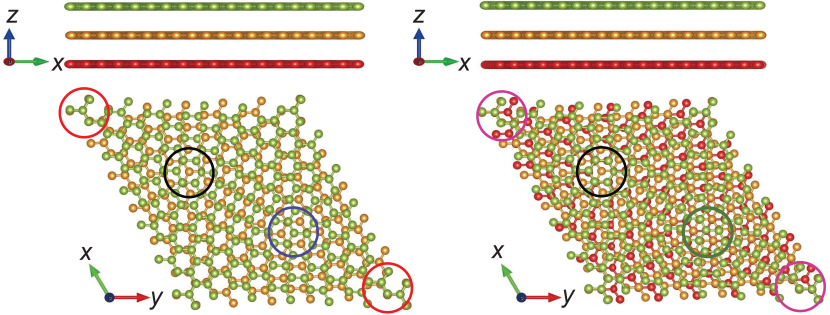
当两个周期性晶格以相对扭转角或晶格常数不匹配的方式叠加时,它们可以形成所谓的 Moire 图案超晶格。在实验上,Moire 超晶格已经通过堆叠二维晶体实现,包括石墨烯、六方氮化硼、二硫化钼等。将 Moire 超晶格与第三层叠加可能形成更大(准)周期结构,即超超晶格。Moire 超晶格上涌现出令人兴奋的新物理现象,包括平带、Mott 绝缘体、非常规超导体以及新的拓扑相。理论研究 Moire 超晶格的主要难点在于超胞通常包含过多原子,超出了直接使用 DFT 或 TB 模型计算的能力,尤其是在考虑原子结构精确性,包括层间相互作用导致的弛豫效应时。我们处理超晶格的策略是根据实验或分子动力学模拟获得的原子结构构建精确的紧束缚模型,然后应用 TBPM 数值研究其性质。我们的策略示例可在以下案例中找到。如果你想在紧束缚近似下研究大超晶格,可以使用我们自制的模拟软件包 TBPLaS 来处理这些复杂的量子体系。
When two periodic lattices are stacked on top of each other with a relative twist or a mismatched lattice constant, they can form a superlattice with the so-called Moire pattern. Experimentally, the Moire superlattice has been realized by stacking two-dimensional crystals together, including graphene, hexagonal boron nitride, molybdenum disulfide and many others. The stacking of a Moire superlattice with a third layer may create even larger (quasi)periodical structures, the super superlattice. Exciting new physics emerges on Moire superlattices, including flat bands, Mott insulators, unconventional superconductors, and new topological phases. The main difficulty in the theoretical study of Moire superlattice lies in the fact that the supercell usually contains too many atoms, which are beyond the direct calculations using either DFT or TB models, especially when considering accurate atomic structures, including relaxation effects due to the interaction between the layers. Our strategy to treat the superlattice is to build an exact tight-binding model from the atomic structure, either obtained from the experiments or molecular dynamics simulations and then apply TBPM to study its properties numerically. Examples of our strategy can be found in the following examples. If you want to study a large superlattice within the tight-binding approximation, you may use our homemade simulation package TBPLaS to handle these complex quantum systems.
代表性出版物
扭曲双层石墨烯-氮化硼异质结构 , npj Computational Materials 8, 73 (2022).
WS2/WSe2 异双层中的激子,
National Science Review, nwab135 (2021).
扭曲三层石墨烯中的超平带,
SCIENCE CHINA Physics, Mechanics & Astronomy 64, 267811 (2021).
低角扭曲双层石墨烯中的伪磁场, Nature Communications 11, 371 (2020).
单层
hBN/Cu(111) 异质结构 , ACS Nano (2018).
石墨烯在六方氮化硼上的研究 , Phys. Rev. Lett. 115, 186801 (2015).
Selected Publications
Twisted
bilayer graphene-boron nitride heterostructures , npj Computational Materials 8, 73
(2022).
Excitons in WS2/WSe2
heterobilayers, National Science Review, nwab135 (2021).
Ultraflat bands in
twisted trilayer graphene, SCIENCE CHINA Physics, Mechanics & Astronomy 64, 267811 (2021).
Pseudo-magnetic fields in low-angle twisted bilayer graphene, Nature
Communications 11, 371 (2020).
Monolayer hBN/Cu(111) Heterostructures , ACS Nano (2018).
Graphene on hexagonal boron nitride , Phys. Rev. Lett. 115, 186801
(2015).
分形结构
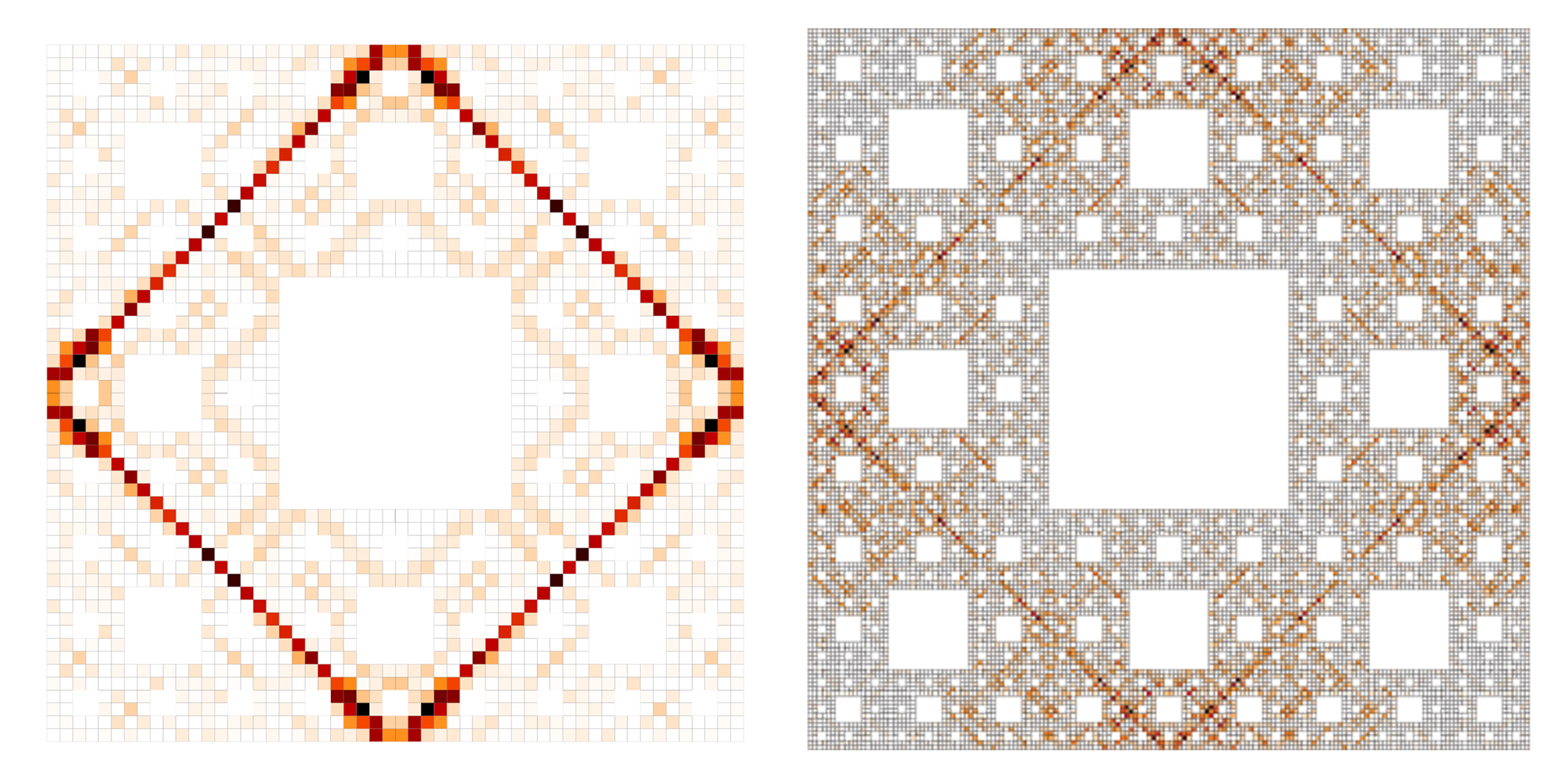
近年来在纳米材料设计和制造方面的进展,使得实验上可以在复杂几何结构中实现电子调控,例如分形结构。分形是在所有长度尺度上自相似的结构,具有非整数维度。由于缺乏平移对称性,分形与周期性晶体有很大不同,因为布洛赫理论不再适用。我们从理论和数值上研究电子在分数维空间中运动的量子力学性质。
Fractals
The recent progress in the design and fabrication of nanoscale materials makes it possible to create electrons
moving in complex geometries such as fractals experimentally. Fractals are self-similar structures at all length
scales with a non-integer dimension. The lack of translational invariance makes fractals quite different from
periodic crystals since Bloch’s theory does not hold anymore. We study theoretically and numerically to understand
the quantum mechanics of electrons roaming in spaces with a fractional dimension.
代表性出版物
功能化 Sierpinski 地毯分形 , Phys. Rev. B 105, 205433 (2022).
有效平面分形中的受限电子, Phys. Rev. B 102, 245425 (2020).
Sierpinski 地毯的霍尔电导, Phys. Rev. B 101, 045413 (2020).
分形中的能量分布 , Phys. Rev. B 99, 075402 (2019).
分形中的等离子体局域化 , Phys. Rev. B. 97, 205434 (2018).
Sierpinski 地毯的光学电导, Phys. Rev. B 96, 235438 (2017).
Sierpinski 地毯中的量子输运 , Phys. Rev. B 93, 115428 (2016).
Selected Publications
Functionalized Sierpinski-carpet fractals , Phys. Rev. B 105, 205433
(2022).
Confined Electrons in Effective Plane Fractals, Phys. Rev. B 102, 245425
(2020).
Hall conductivity of Sierpinski carpet, Phys. Rev. B 101, 045413
(2020).
Energy
distributions in fractals , Phys. Rev. B 99, 075402 (2019).
Plasmon confinement in fractals , Phys. Rev. B. 97, 205434
(2018).
Optical conductivity of Sierpinski carpet, Phys. Rev. B 96, 235438
(2017).
Quantum transport in Sierpinski carpets , Phys. Rev. B 93, 115428
(2016).
准晶
准晶具有准周期结构,缺乏长程有序性。它缺乏平移对称性,但具有旋转对称性。自 1982 年 Dan Shechtman
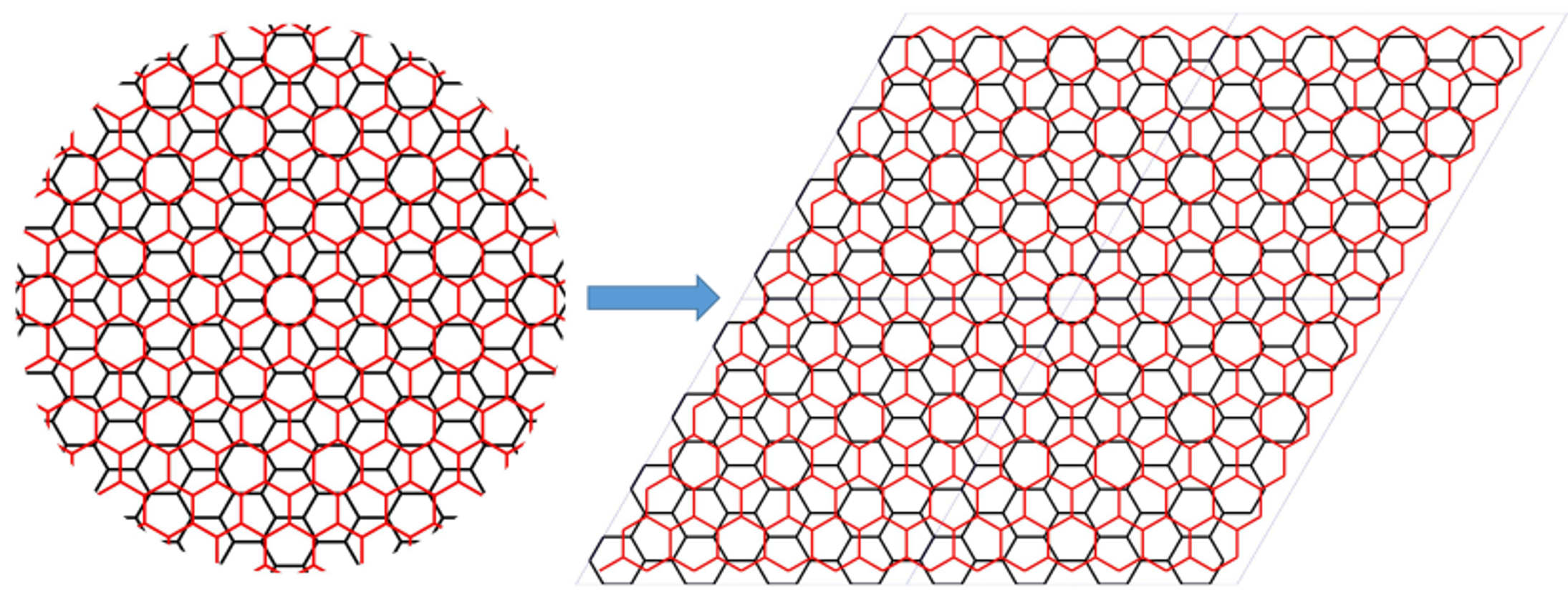
首次发现以来,已有数百种准晶被报道和确认,大多存在于铝合金中。我们最近对准晶的理论研究主要集中在十二角准晶,这类准晶最近在扭曲双层石墨烯中被成功制备。准晶中的层间杂化产生了丰富的物理现象,这些现象在具有平移对称性的周期晶体中并不存在。
Quasicrystal
A quasicrystal has a quasiperiodic structure that is ordered but not periodic. It lacks translational symmetry but
presents rotational symmetries. Since the original discovery by Dan Shechtman in 1982, hundreds of quasicrystals
have been reported and confirmed, most often in aluminium alloys. Our recent theoretical investigation of
quasicrystals mainly focuses on dodecagonal quasicrystals which have been fabricated recently in twisted bilayer
graphene. Interlayer hybridization in quasicrystal leads to rich physics which are not presented in periodic
crystals with translation symmetry.
代表性出版物
范德华准晶中的兼容性关系 , Phys. Rev. B 105, 245415 (2022).
石墨烯准晶及其他双层石墨烯系统中的层间杂化 , Phys. Rev. B 105, 125403 (2022).
准晶电子态的压力与电场依赖性, Phys. Rev. B 102, 045113 (2020).
双准晶的电子结构, Phys. Rev. B 102, 115123 (2020).
十二角双层石墨烯准晶及其近似晶体 , npj Computational Materials 5, 122 (2019).
Selected Publications
Compatibility relationships in van der Waals quasicrystals , Phys. Rev.
B 105, 245415 (2022).
Interlayer hybridization in graphene quasicrystal and other bilayer graphene
systems , Phys. Rev. B 105, 125403 (2022).
Pressure and electric field dependence of quasicrystalline electronic states,
Phys. Rev. B 102, 045113 (2020).
Electronic structure of double quasicrystal, Phys. Rev. B 102, 115123
(2020).
Dodecagonal bilayer graphene quasicrystal and its approximants , npj
Computational Materials 5, 122 (2019).
量子自旋系统与量子计算
Quantum Spin Systems and Quantum Computation
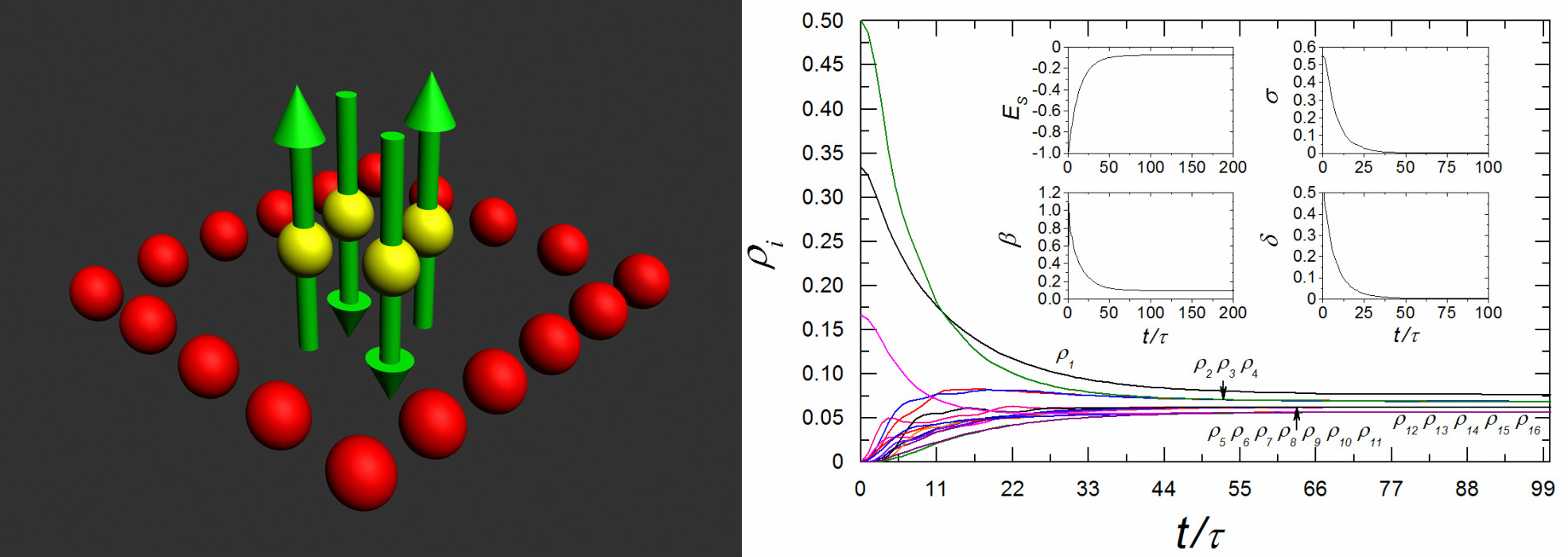
量子系统如何有效地表现为经典,对于量子物理的基础理论具有重要意义。越来越明显的是,量子系统的经典特性可以由其环境诱导。过去几年中,我们使用一个简化模型研究了量子自旋系统的退相干与热化过程。研究表明,像正则系综这样的经典态可以通过纯量子动力学达到。对量子自旋系统建模的扩展进一步导致了量子计算机的模拟,其中量子计算的逻辑操作由具有特定哈密顿量的量子自旋系统构建。这是一种非常高效的量子计算机模拟方法,尽管可模拟的量子比特数量受到计算机内存的限制,但它仍提供了一个理论工具,用于在考虑环境影响和/或内部或外部噪声的情况下研究实际设备中量子计算机的性质。
The manner in which a quantum system becomes effectively classical is of great importance for the foundations of quantum physics. It has become increasingly clear that the symptoms of classicality of quantum systems can be induced by their environments. Over the past years, we used a toy model to explore decoherence and thermalization of quantum spin systems. We demonstrate that a classic state such as canonical ensemble is reachable via pure quantum dynamics. An extension of the modeling of quantum spin systems lead to the simulation of quantum computers, in which the logical operations of the quantum computation are constructed by a quantum spin system with specified Hamiltonian. This is a very efficient way to simulate the quantum computers, although the number of the qubits that can be simulated is limited by the memory of the machine, it still provides a theoretical tool to investigate the properties of quantum computers in a real device considering the effects of the environments and/or possible noises due internal or external sources.
代表性出版物
全球最大模拟通用量子计算机的新记录:48个量子比特 , Comp. Phys. Comm. 237, 47 (2019).
有限温度下正则热态系综中的量子退相干与热化 , Phys. Rev. A 93, 032110 (2016).
Selected Publications
A new world recorder of the largest simulated universal quantum computer: 48
qubits , Comp. Phys. Comm. 237, 47 (2019).
Quantum Decoherence and Thermalization at Finite Temperature within the Canonical
Thermal State Ensemble , Phys. Rev. A 93, 032110 (2016).
量子计算与量子模拟云平台
Quantum Computing and Quantum Simulation Cloud Platform
利用量子力学原理进行信息处理的一种技术
Simulation of Multimillion-To-Billion Atoms within Tight-binding Approximation
全平台一体化:将量子计算模拟、编译、操控三大板块整合到统一的云平台中,减少用户跨平台操作的复杂性。
高易用性和可靠性:完善的网站前后端系统与模块化设计,为用户提供直观、高效的操作体验。
支持科研与工业应用:适用于量子计算、材料设计、物理模拟等多个领域,覆盖从基础研究到实际应用的多种需求。
更多关于云平台的信息请访问 https://quantumclouds.cn/
Integrated Platform: Quantum simulation, compilation, and control are unified into a single cloud platform,
minimizing the complexity of cross-platform operations.
High Usability and Reliability: A robust front- and back-end system with modular design provides users with an
intuitive and efficient operating experience.
Supporting Research and Industrial Applications: Applicable to quantum computing, materials design, and physical
simulations, covering diverse needs from fundamental research to practical applications.
For more information about the cloud platform, please visit https://quantumclouds.cn/